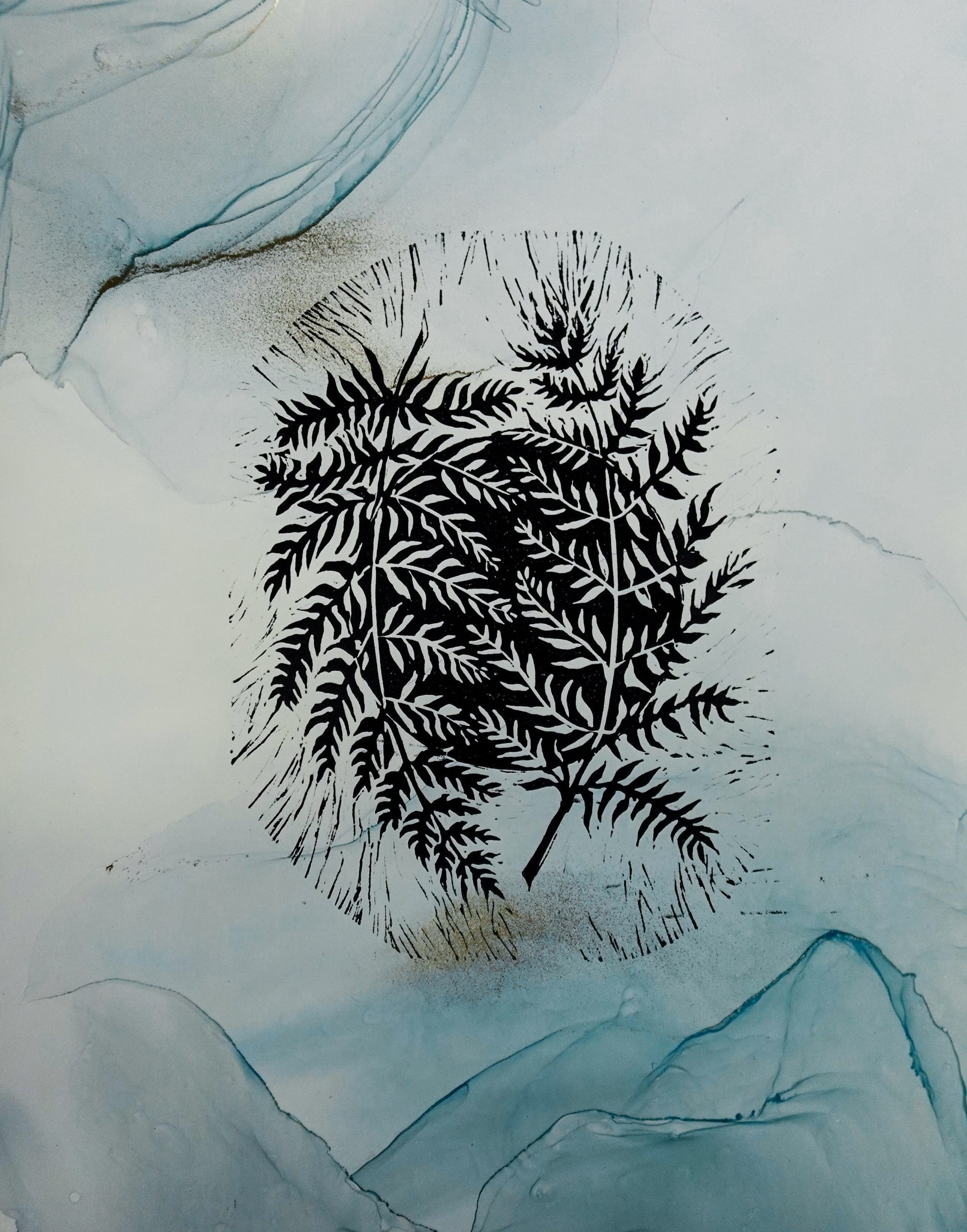
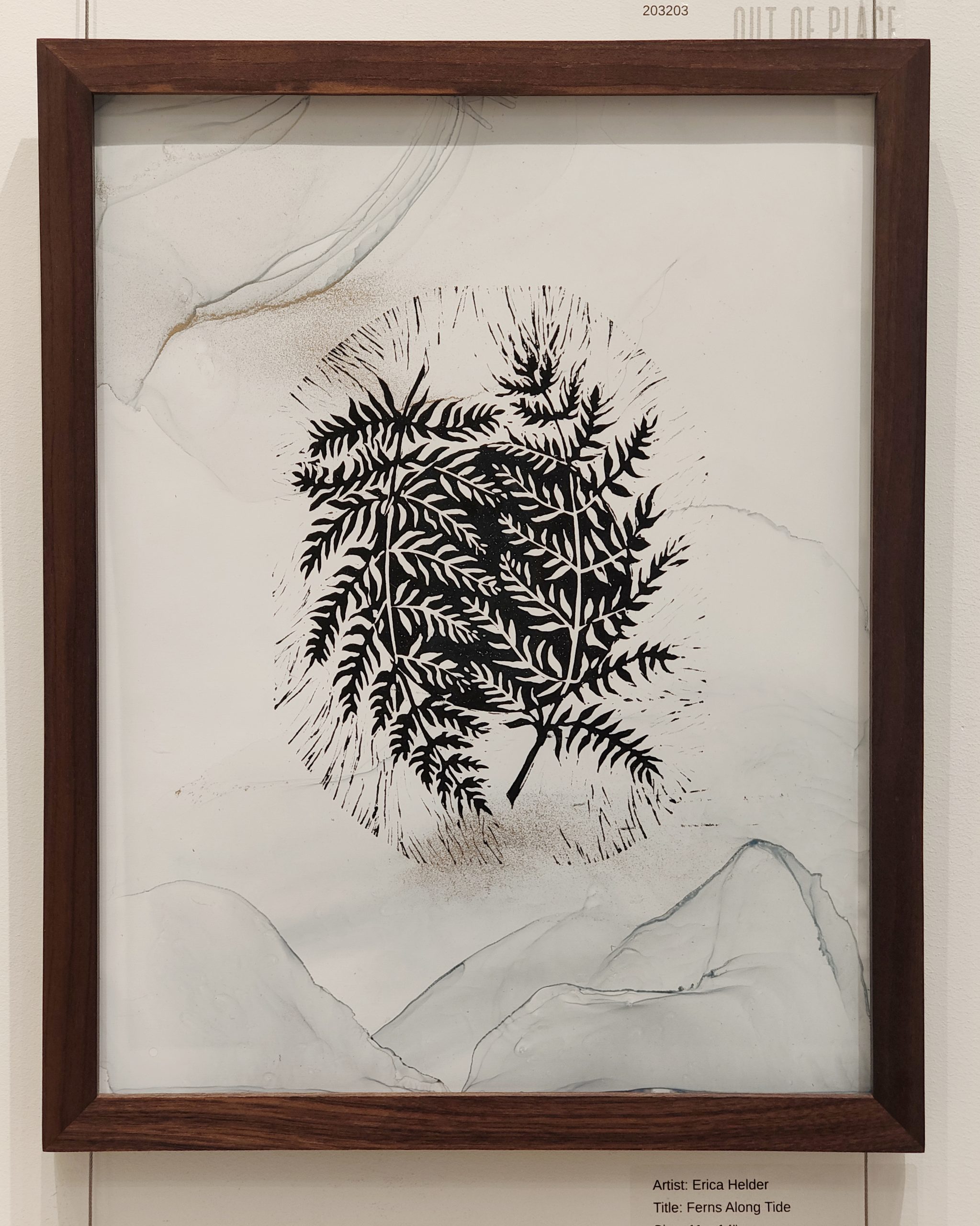
Ferns Along Tide
$450.00
Artist: Erica Helder
Medium: Alcohol ink, ground brass, and linocut on polypropylene.
Artist Statement:
My practice has long been rooted in fluidity, both in material and in meaning. Working primarily in the worlds of abstraction and fluid media, I explore movement, emotion, and the changeability of perspective. These methods allow me to respond to “place” as something felt or experienced; permeable, and internal.
Ferns Against Stone/Through Moss/Along Tide/Under Light marks a departure from my established language. Created during an artist residency above the Arctic Circle in northern Norway, it reflects a direct encounter with a landscape that challenged my usual approach. The terrain there inspired texture, edge, and contrast; qualities generally absent from my typical work. Where my previous work has sought to blur boundaries, suddenly my inspiration required them. I found them through the process of linocut.
In the Arctic environment, “place” became both external and embodied. The austerity of the land and its harsh edges reshaped what I saw, and my own distance from familiar comforts and routines created an internal dissonance; I was both present in the landscape and aware of my own displacement within it. This tension is embedded in the work, where the abstraction gives way to structure, and the fluidity is interrupted by contrasting texture.
Ferns Against Stone is an attempt to hold that friction between familiarity and estrangement. I interpret them as records of my own adaptation, where feeling “out of place” became a part of my creativity instead of a limitation. I hope that the viewer can enter that same state of tension and openness; to consider how their own sense of place is affected by movement, form, memory, and distance, and reflect on the way disruption can shift both what we see, and how we interpret it.
The works created in the Arctic reflect an ongoing negotiation between my internal visual language and the demands of an unfamiliar land. They ask what it means to be “out of place” – both geographically and within one’s own practice – and how that dislocation can open new ways of seeing, feeling, and creating.
Artist Biography:
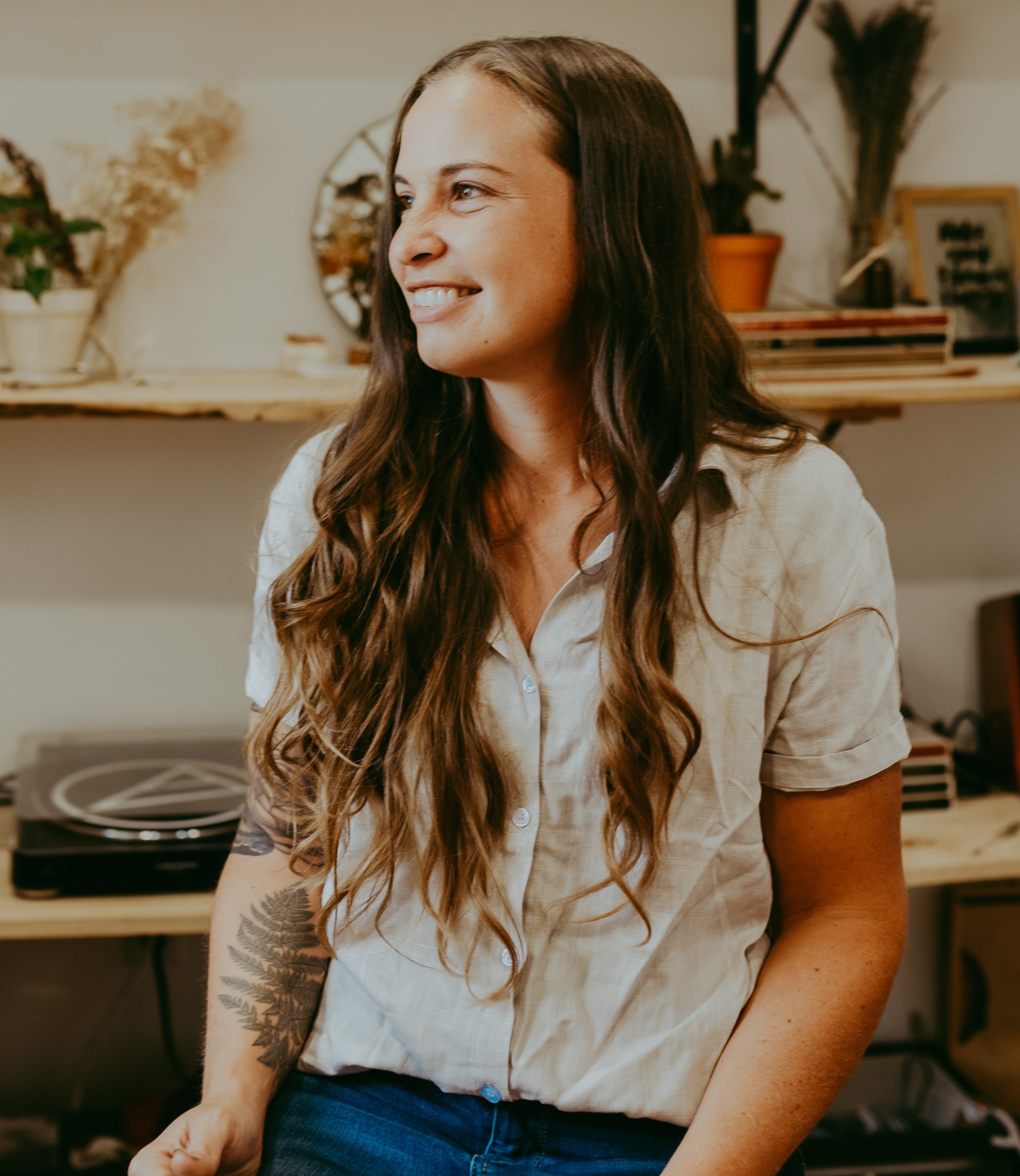
Erica Helder is a Canadian visual artist working out of her home studio in Brantford, Ontario. Drawing on her education in the field of Psycholinguistics, and creating with fluid media, her abstract pieces use colour, movement, and negative space to interpret emotions. After my mother passed, I received a box containing the art I had created in my childhood. The first entry in my earliest sketchbook was a self-portrait, underneath which I had written “when I grow up, I want to be an artist, because my mom says I do great work”. This is the first thing you see when you walk into my studio. Painting was my constant during the tumultuous years of my childhood. For nearly a decade, I studied realism and oil painting under local artist Kaye Crabtree. However, having been thoroughly instructed that art was an unrealistic career, I pursued degrees in French, Psychology, and Education, culminating in a Master of Arts in Psychology of Linguistics from the Sorbonne. Upon graduation, I began to experiment with blending the psychology of colour with intentional movement in abstract art. I began to find my voice again as an artist, learning an entirely new medium in ink. Through abstract art, I interpret abstract sentiments; longing, uncertainty, or wonder, for example. I create a body of work that explores the concept thoroughly, then begin again. My inspiration is often found in tangible pieces of the world around us that hold secrets and beauty. I’ve grown quite skilled at the process of noticing small magic. I believe these glimmers are a part of what connects us as humans, and work to include their metaphors in my collections as I paint. My practice is fueled by a search for translating the untranslatable. Using my background in psychology, I break down concepts that define the human experience into abstract swaths of colour, whitespace, and movement. For years I have worked with materials that take on the quality of the world around them; the temperature, gravity, and humidity of the workspace affects the outcome– meaning every piece is a collaboration with the space where it was made.